
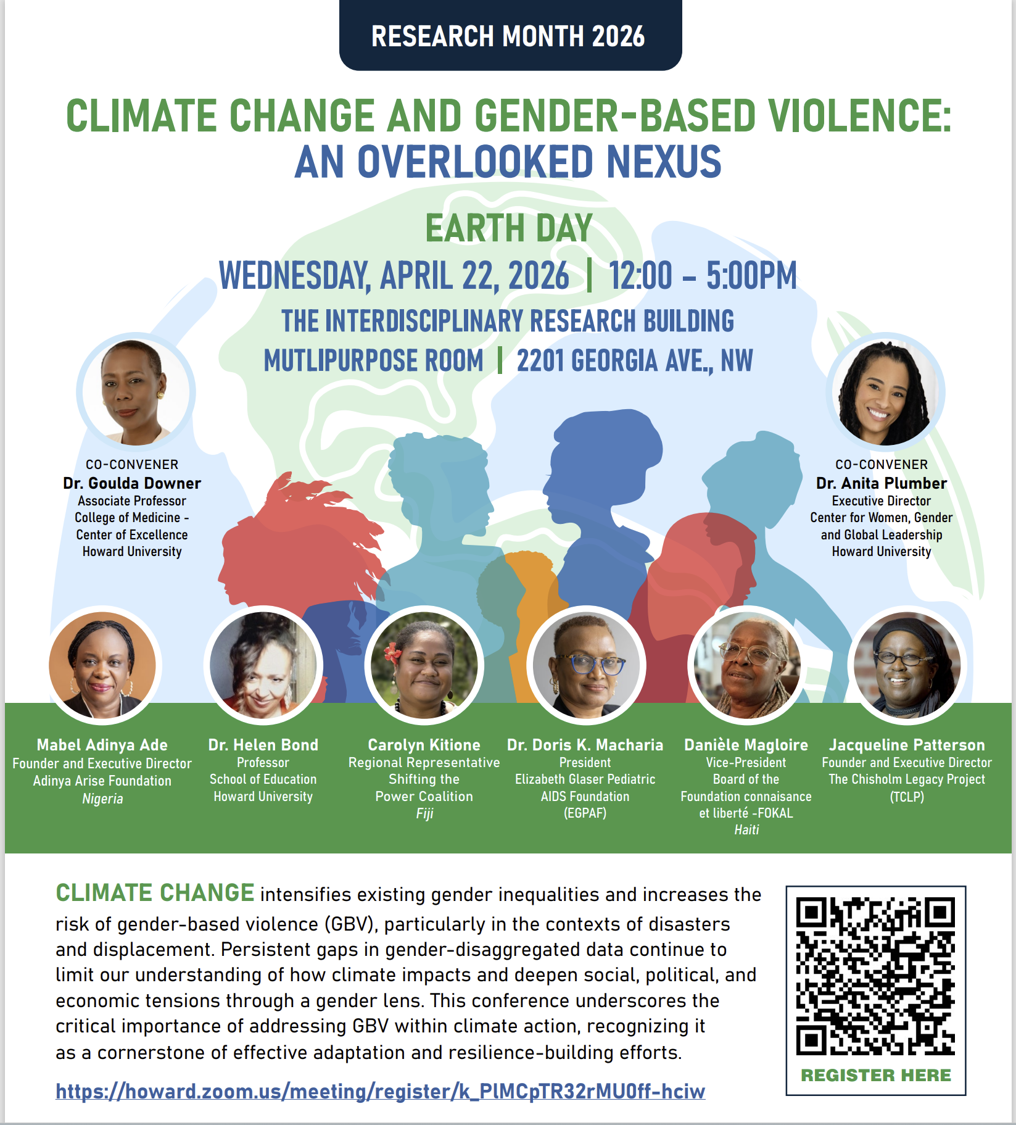
Join Dr. Helen Bond (Professor in the Howard University School of Education and SDSN USA co-chair) along with the Howard University College of Medicine, and the Center for Women, Gender, and Global Leadership, for a half-day Research Month event that brings this overlooked nexus into focus.
Is climate change gender neutral?
As climate-driven disasters intensify—from floods and droughts to heatwaves and hurricanes—existing social inequalities deepen, placing women and girls at heightened risk of violence.
Research Month: Climate Change and Gender Based Violence: An Overlooked Nexus
Wednesday, April 22, 2026, 12:00pm to 5:00pm
Interdisciplinary Research Building, Multipurpose Room
2201 Georgia Ave NW, Washington, DC 20059
Register: https://howard.az1.qualtrics.com/jfe/form/SV_1H9T2SnMs9j6YUS
Emerging evidence shows a troubling connection: for every 1°C rise in temperature, intimate partner violence increases by 4.7%. Displacement, resource scarcity, and the breakdown of protection systems during climate emergencies create conditions where gender-based violence (GBV) escalates while safeguards fail. Yet, despite growing recognition of climate change as a global threat, GBV prevention remains largely absent from disaster risk reduction and climate adaptation frameworks.
Why Attend?
This event will explore how climate-related stressors—such as droughts, floods, heatwaves, and displacement—exacerbate GBV and widen gender disparities. Participants will engage with evidence, policy gaps, and practical strategies for integrating GBV prevention into climate and emergency response planning, strengthening community resilience and advancing human rights.
Key Objectives
Examine evidence linking climate change impacts to increased GBV
Highlight system-level gaps in emergency and disaster response
Explore data connecting temperature increases to intimate partner violence
Discuss how displacement weakens protection systems and heightens exposure to violence
Foster collaboration across academic, governmental, and community-based sectors addressing the climate–GBV intersection
Who Should Attend
Academics and researchers (climate science, public health, gender studies, social work)
Policymakers at local, national, Caribbean, and global levels
NGOs focused on climate resilience, GBV prevention, and humanitarian response
Students and trainees
Emergency management and government representatives
Health and emergency response professionals
Community leaders, advocates, and survivor-centered organizations
Be part of the conversation shaping safer, more resilient communities.
This Research Month event challenges us to rethink climate action—by placing gender equity and protection at the center.